
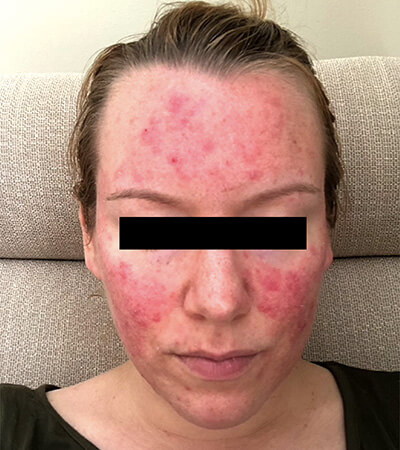
 Rosacea and acne can look similar, but they are actually two completely different skin conditions.
Acne vulgaris is a product of many factors, involving clogged hair follicles, hormonal stimulation of oil glands, inflammation and bacteria. Comedones — blackheads and whiteheads from clogged pores — are often present in acne, and pimples on parts of the body beyond the face are common. Acne is most commonly seen in teens, and is usually (but not always) a transient condition.
In contrast, rosacea is a chronic disorder that typically begins in adulthood. Its most common feature is redness (erythema) which may come and go and may become more permanent over time. Rosacea does not cause comedones, and the bumps and pimples of rosacea most often occur primarily in the central portion of the face.
“Rosacea is usually the center of the face. Acne can be the center of the face as well, but when it is, it's mostly comedones, and that would not be seen in rosacea,” said Dr. Hilary Baldwin, associate professor of Dermatology at Rutgers Robert Wood Johnson Medical Center, in an interview with HCPLive. “The size of the pimples matter. When you see big, juicy red papules…that's mostly acne. Rosacea papules, although quite red, tend to be smaller than acne papules.”
Adding to the confusion, rosacea and acne may occur together, and this combination is poorly understood. Unfortunately, treating the two skin conditions together is challenging because the treatments for acne tend to be too harsh for sensitive rosacea skin.
However, both conditions share similar lifestyle triggers, such as diet, sleep and skin care habits, suggesting that some form of relief could be possible for patients through lifestyle adjustments. Two recent studies looked at risk factors for the comorbidity of acne and rosacea and potential effective treatments.
In one study, researchers surveyed 300 rosacea patients to determine lifestyle factors that might put them at higher risk for acne vulgaris.1 The prevalence of acne in this group was 30.33%, much higher than the 14.83% prevalence in the general population. After analyzing risk factors such as skin care, diet, and other lifestyle habits, the study authors determined the most statistically significant risk factors to be sleep duration and sunscreen usage. Notably, several risk factors linked to acne in the general population, such as ethnicity, marital status, income, occupation, and cleaning product usage, did not appear to be significant factors for acne prevalence among rosacea patients.
Longer sleep duration was found to be protective against the onset and worsening of acne vulgaris in rosacea patients. This aligns with previous studies, which have shown sleep’s significant role in “reducing systemic inflammation levels and promoting the repair of the skin barrier,” the researchers wrote.
Sunscreen use was also found to increase the risk of acne vulgaris in rosacea sufferers, potentially due to the thick, occlusive nature of some sunscreen products. However, sun protection is an essential component of rosacea care, making this yet another contradictory and challenging component of the comorbidity. Rosacea patients with acne should choose a sunscreen that works best for their skin and use it regularly. In addition, physical sun blocking items, such as hats, sunglasses and umbrellas, can also help prevent flare-ups from sun exposure.
The other study looked into possible treatments for rosacea and acne vulgaris.2 The researchers created a standardized treatment plan for acne and rosacea patients, consisting of a group that received skin cleanser and moisturizer and pre-scheduled, personalized digital education support, and a control group that did not receive any of this. Digital educational content covered such topics as facial cleansing and moisturizing, sun protection, lifestyle adjustments, and reminders to take medication. “Unlike general educational pushes, this consultation provided specific guidance for actual concerns at different treatment stages,” the investigators wrote. The digital education group and the control group were both given doxycycline and topical azelaic acid as their treatment regimen.
The group receiving skin care and digital educational support experienced higher 12-week clearance (54.6% vs 34.4%) and were less likely to have a relapse after 24 weeks, the researchers found. They hypothesized this may be due to the continued personalized support and reminders, which contributed to increased adherence to the protocol, even after symptoms began improving.
The association between rosacea and acne remains difficult and contradictory in terms of treatment, but these two studies support the idea that lifestyle changes and improved skin care plus online educational support may contribute significantly to the improvement of both skin conditions.
References:
1. He S, Cen X, Zhong J, et al. Risk factors for acne vulgaris among rosacea patients: a cross-sectional study. Front Public Health. 2026 Jun 24;14:1859962. doi: 10.3389/fpubh.2026.1859962. PMID: 42422699; PMCID: PMC13341721.
2. Qing Y, Zhang K, Xu B, et al. Clinical outcomes associated with a digital standardized skin care regimen in acne-rosacea comorbidity: A real-world longitudinal study with cross-lagged and mediation analyses. J Am Acad Dermatol. 2026 Jul 14:S0190-9622(26)02984-1. doi: 10.1016/j.jaad.2026.06.090. Epub ahead of print. PMID: 42455099.