
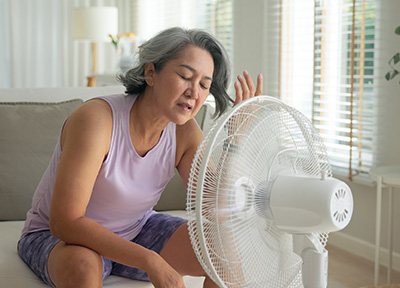
 Menopause is the stage of life when menstruation stops, and is defined as the moment when a person has not menstruated for 12 consecutive months. But the four to 10 years leading up to menopause commonly involve a wide variety of physical, mental and emotional symptoms caused by decreasing estrogen and progesterone. This tumultuous stage of life is called perimenopause. In perimenopause, symptoms such as irregular periods, hot flashes, mood disorders, joint issues, brain fog and insomnia are quite common.
Research on perimenopause and rosacea is somewhat limited, but even so, recent studies have shown perimenopause to be a time of both increased incidence of rosacea and worsening of existing symptoms for current rosacea patients.1,2 Some evidence also suggests that women in perimenopause may have different triggers and experience different signs and symptoms than younger women.
“During perimenopause, estrogen levels fluctuate markedly and eventually decline,” said Dr. Shoshana Marmon, assistant professor and director of clinical research in the dermatology department at New York Medical College.
This natural loss of sex hormones happens to all menstruating people and can lead to thinning and drying skin, higher susceptibility to irritation and a disrupted skin barrier, all of which can predispose a person for an initial rosacea diagnosis or worsening of signs and symptoms. In addition, inflammation increases throughout the body during menopause, and hot flashes are common, particularly on the skin of the face.
“For women who experience hot flashes, the associated heat and flushing may aggravate rosacea symptoms,” Dr. Marmon noted. Hormone fluctuation during perimenopause can make blood vessels more reactive, drawing heat to the face the same way certain triggers do, and can lead to rosacea flare-ups.3
More holistically, perimenopause is a time of life when increased stressors are common, and this can make symptom management difficult in a number of areas. Getting good sleep, eating well and exercising regularly, and practicing stress-coping habits can become challenging, which can lead to an exacerbation of rosacea symptoms or an initial diagnosis of it.
“The core treatment of rosacea does not change during perimenopause. Treatment should be directed at the patient’s specific features, using established therapies,” said Dr. Marmon. Applying prescription topical medications and/or taking oral medications daily, keeping a regular diary of triggers and their associated signs and symptoms, doing activities to promote stress relief, gently cleansing skin, and regularly applying sunscreen all remain essential. “Gentle skin care, regular moisturization and daily sun protection remain particularly important, since declining estrogen is associated with dryness and impaired barrier function,” she said.
One potential addition to rosacea care in perimenopause is hormone therapy, which will depend on an individual’s needs and medical history. Hormone therapy is often used to reduce hot flashes and improve sleep and energy levels, which may help improve rosacea signs and symptoms in some patients.3 However, studies seem to indicate a complex relationship between rosacea and hormones, so menopause hormone therapy may not be the right choice for everyone.4
References:
1. Roster K, Fleshner L, Karatas TB, Ecanow A, Sayegh A, Farabi B, Marmon S. Menopause and Common Dermatoses: A Systematic Review. Am J Clin Dermatol. 2026 Jan;27(1):67-84. doi: 10.1007/s40257-025-00994-0. Epub 2025 Dec 2. PMID: 41331233; PMCID: PMC12860752.
2. Yang F, Wang L, Jiang X. Clinical characteristics of rosacea in perimenopausal women. Skin Res Technol. 2024;30(1):e13542. doi 10.1111/srt.13542.
3. Rajab, Fazila. Rosacea and Menopause. Dermatology Times, February 2023 Vol. 44. No. 02. dermatologytimes.com/view/rosacea-and-menopause
4. Wu WH, Geng H, Cho E, Eliassen AH, Drucker AM, Li TY, Qureshi AA, Li WQ. Reproductive and hormonal factors and risk of incident rosacea among US White women. J Am Acad Dermatol. 2022 Jul;87(1):138-140. doi: 10.1016/j.jaad.2021.06.865. Epub 2021 Jul 15. PMID: 34274412.