 Rosacea is not just a skin problem. Researchers increasingly see it as a condition involving three connected systems: the nerves, the blood vessels, and the immune system.1 When these systems are overactive, it can lead to a range of symptoms, including redness, a burning sensation, visible small blood vessels, and bumps and pimples.
The involvement of the nervous system may help explain why stress makes rosacea worse. In a National Rosacea Society survey, stress was reported as the second most common trigger, after sun exposure. In another survey of 544 people with rosacea, 62% said they had a stress-related flare at least once a month.
This connection suggests that calming the nervous system might help reduce flares. The vagus nerve is the main nerve of the body’s “rest and digest” system, which counterbalances the “fight or flight” stress response.2 Most of the vagus nerve runs deep inside the neck and body, but one small branch reaches the skin of the outer ear. This makes the ear a convenient place to stimulate the vagus nerve.
A 2025 study published in JAMA Dermatology demonstrated this approach.3 Researchers used a small electrical device to stimulate the vagus nerve through the outer ear. They found that for people with the redness-predominant type of rosacea, this intervention reduced facial redness.
A new study asked whether a simpler, device-free approach could work, too.4 Researchers in China enrolled 204 people with rosacea, most of whom were women in their early thirties. All participants continued to receive standard first-line treatment throughout the study.
The participants were randomly divided into two groups:
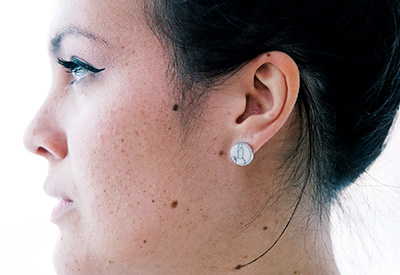
- The active acupressure group had tiny plant seeds taped onto one of two spots in the hollow of each ear, right over the vagus nerve.
- The comparison group had the same type of seed taped to a small bump on the upper rim of each ear. This spot feels similar when pressed, but it’s not connected to the vagus nerve.
Participants pressed on the seeds for 30 seconds three times a day. They were also allowed to press on the seeds more often during flare-ups. The way the study was designed meant both groups had a similar experience pressing the seeds on their ears. This helped researchers separate the effect of stimulating the vagus nerve from the effect of pressing on the ear itself.
After eight weeks, about 57% of people in the active group had skin that was rated clear or almost clear, compared with about 35% in the comparison group.
These results are encouraging, but larger studies are needed to determine whether they apply to people with rosacea more broadly. Even so, this new study suggests that ear acupressure may be a simple, inexpensive way to manage rosacea symptoms in addition to standard treatment.
References:
1. Yang X, Yang W, Chen N, Li D, Xu Y. Therapeutic progress in rosacea: Targeting the neuro-vascular-immune triad. Front Immunol. 2026;17:1876564. doi:10.3389/fimmu.2026.1876564
2. Geng D, Yang K, Fu Z, Zhang Y, Wang C, An H. Circadian stage-dependent and stimulation duration effects of transcutaneous auricular vagus nerve stimulation on heart rate variability. PLoS One. 2022;17(11):e0277090. doi:10.1371/journal.pone.0277090
3. Li J, Wei J, Zhang M, et al. Transcutaneous auricular vagus nerve stimulation treatment for erythematotelangiectatic rosacea: A randomized clinical trial. JAMA Dermatol. 2025;161(12):1229-1237. doi:10.1001/jamadermatol.2025.3796
4. Xu B, Chu J, Wang Y, et al. Device-free auricular acupressure for rosacea: A randomized clinical trial. Published online October 14, 2026. JAMA Dermatol. doi:10.1001/jamadermatol.2026.3999