
While medical therapy can address the underlying physical aspects of rosacea over time, makeup can help instantly improve the look of your skin and boost your self-confidence about your appearance. Here are some tips to help you look and feel your best.
Get a clean start. Before applying makeup, cleanse and moisturize your face with skin care products appropriate for your skin. Always treat skin gently. Do not rub, scrub or pull on skin with your fingers, makeup sponges or even a washcloth or towel, as this may cause irritation.
Choose the right tools. Use the same care in choosing your tools as you do in choosing the cosmetics themselves. Soft anti-bacterial brushes may be best, since even the oil and bacteria on your fingers may irritate skin. If you want to try a soft, damp makeup sponge, gently press and roll the product into your skin to minimize irritation. Do not drag the sponge across your skin, and be sure to discard when finished.
Remember, makeup has no gender. Wearing base, foundation and concealer can make your skin tone look more even and boost your confidence, no matter what your gender! If you don’t want to look like you’re wearing makeup, try subtle products and techniques to give a “no makeup” look. Even just a tinted moisturizer may help reduce the appearance of redness.
Where to Begin
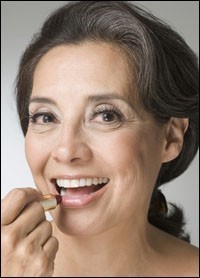
- Keep it simple. The more ingredients and products you apply to your skin, the higher the likelihood that an ingredient or product may aggravate it. Finding a few reliable, high-quality products will make a huge difference in the health of your skin. It may also be helpful to use multi-function products, such as a green-tinted base that also contains sunscreen. Always test a new product in a peripheral area — your neck, your arm — before using it on your face to make sure your skin doesn't react to it. Avoid any products that burn, sting or irritate your skin. Many rosacea patients report that fragrances can be triggers for flare-ups, so look for unscented products whenever possible.
- Use a green-tinted base. A sheer, green-tinted primer is a good choice for a makeup base — it can help visually correct redness and even out skin tone. Get one with UVA/UVB protection and you'll help shield skin from sun exposure that can aggravate rosacea. A protective base has another bonus, too: it helps your makeup last longer.
- Choose oil-free foundation and concealer. Look for an oil-free foundation that offers the level of coverage you prefer. Coverage levels can range from sheer to full. And for both foundation and concealer, choose your shade carefully. Foundation should match your natural skin tone as closely as possible, while concealer should be just one shade lighter than your natural skin tone. Most modern foundations and concealers offer a wide variety of skin tone options to choose from. Use of a soft, anti-bacterial makeup brush is recommended to minimize irritation, but depending on your personal sensitivity, you may be able to try soft sponges or possibly clean fingertips.
- How to apply foundation. Use a light touch when applying foundation. You may want to use an antibacterial foundation brush to apply it. For brush application, start by applying a small amount of liquid foundation to the back of your hand. Dab with the brush and smooth over your face, starting in the center and blending outward. For cream or powder foundation, sweep the brush across the surface of the compact and apply to your face. Use broad strokes for large areas of the face: cheeks, forehead and chin. Use the edge of the brush to reach narrow areas: nose, mouth, eyes and hairline. To use sponges or fingertips instead, gently and slowly pat or roll product on. Do not wipe or rub. Blend well. Be sure to clean tools between uses and discard disposable items.
- How to apply concealer. Use an antibacterial concealer brush or sponge to lightly dot concealer under your eyes, starting at the inner corner and working outward. Blend well for a seamless look. You can hide bumps or visible blood vessels by dabbing and blending concealer directly onto each area, then using foundation all over to create a more even tone.
What to Use
- Consider cover-corrective makeup. Especially for those with moderate to severe rosacea, cover-corrective cosmetics may be an appropriate option. Available in a choice of formulations with UVA and UVB sun protection and a wide array of tones to match your natural skin color, they can thoroughly conceal many types of skin imperfections to create a flawless look.
- Explore the benefits of mineral powder. Mineral makeup is often a good choice for skin with rosacea, as it typically doesn't contain potentially irritating ingredients. There are also innovative mineral powder formulas specifically formulated to color-correct redness. Dust a yellow-toned mineral powder over foundation, or use it over your protective base instead of foundation to help further tone down the look of redness.
- To blush or not to blush. Mineral powder blushers are also available, but since skin already tends to have a lot of color, go easy on cheek color if you use it at all. Choose sheer blush formulated for sensitive skin and apply sparingly with an antibacterial brush, sweeping it from the apples of the cheeks toward the temples.
- Opt for extra-gentle eye makeup. Eyes are sensitive to begin with, and if yours have signs and symptoms of ocular rosacea, it's especially important to treat the eye-area skin gently. Select products designed for sensitive eyes that have been ophthalmologist tested — and allergy- tested, fragrance-free formulas may be ideal. Mascara and eyeliner should be easy to apply and remove without pulling or tugging on the eyes. Look for mascara formulas that can be gently removed by simply rinsing with warm water. Mineral powder eye shadow may be the perfect choice for eyes susceptible to rosacea symptoms. Neutral colors, both in shadow and eye pencils, may also be less irritating than strong jewel tones since they have less pigment.
- Go for neutral lips. Lips will shine in neutral shades close to your natural lip color. Avoid red shades that may exacerbate the look of redness in your skin.
For useful advice on caring for skin with rosacea, visit these areas of the site: